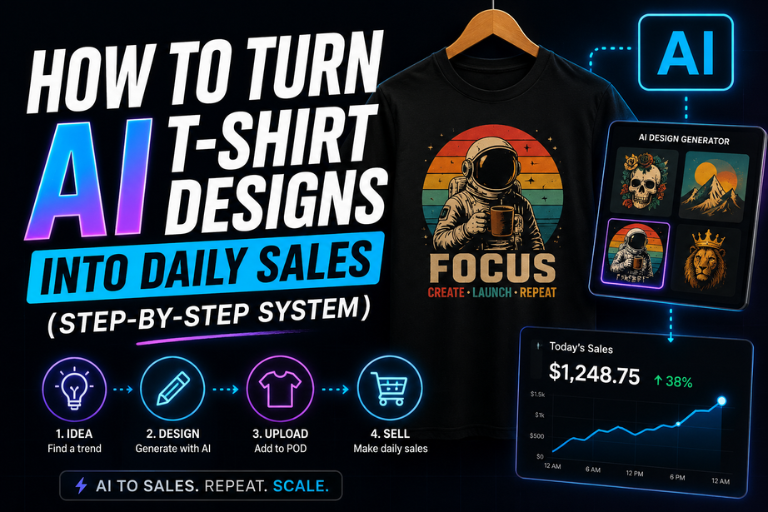
How AI Print on Demand Is Creating a New Type of Seller
Let’s not pretend this is easy.
If you’re starting from zero with print-on-demand, it can feel like you’re doing everything right… and still getting nowhere.
You’re making designs.
Uploading them.
Trying different ideas.
Maybe even spending hours tweaking things that probably didn’t need tweaking.
And then you check your store.
Nothing.
Or worse—one sale that never repeats.
That’s usually the point where people either quit… or start chasing shortcuts.
But here’s the reality nobody explains properly.
Getting to consistent sales is not about luck, and it’s definitely not about pumping out hundreds of random designs.
It’s about building a workflow that actually makes sense from start to finish.
And once you see it laid out clearly, you’ll realize something:
You don’t need more effort.
You need better direction.
The opportunity in print-on-demand is still massive.
Platforms like Redbubble, Etsy, and Amazon Merch on Demand have made it possible to build a store without inventory, without shipping headaches, and without upfront investment.
At the same time, AI tools like Midjourney and DALL·E have made design creation faster than ever.
So on paper, everything looks perfect.
But here’s what actually happens in practice.
Everyone has access to the same tools.
Everyone is uploading designs.
And most of those designs are going nowhere.
Why?
Because the barrier to entry dropped… but the barrier to success didn’t.
If anything, it got higher.
And the difference now is simple:
The people making money are not working harder.
They’re working with a system.
Let’s walk through the typical beginner workflow.
It usually looks something like this:
You open an AI tool.
You type a basic prompt.
You generate a few designs.
Upload them to your store.
Add some tags.
And then wait.
When nothing happens, you assume the designs weren’t good enough.
So you make more.
Different styles. Different niches. Different approaches.
Still nothing.
And this is where it gets frustrating.
Because it feels like you’re doing the work.
But the results don’t match the effort.
The problem is not your effort.
It’s that the workflow is incomplete.
There’s no demand validation.
No clear audience.
No traffic.
No feedback loop.
Just output.
And output without direction doesn’t create sales.
So let’s fix it properly.
Here’s the workflow that actually works:
“Research → Idea → Design → Listing → Traffic → Optimization”
Each step has a purpose.
Each step builds on the previous one.
And if you skip one, the system breaks.
What most people do is jump straight into design.
What you need to do is follow the sequence.
Let’s go through it.
Section 1: Research (Where Everything Starts)
This is the part most people rush.
And it’s also the part that determines whether anything else will work.
Instead of creating designs immediately, you start by looking at what’s already selling.
Go to Etsy or Redbubble.
Search for:
* funny t-shirt
* sarcastic shirt
* relatable shirt
Now slow down.
Don’t just scroll.
Look for patterns.
What You’re Looking For
You’re not trying to find one good design.
You’re trying to find repeated ideas.
If you see:
* Similar phrases across multiple listings
* Designs with lots of reviews
* Themes that keep showing up
That’s not random.
That’s demand.
Example
You’ll notice things like:
* Burnout humor
* Introvert jokes
* Overthinking quotes
* Low-effort humor
These themes exist because people buy them.
What Most People Do Wrong
They try to be unique too early.
They think:
“I need something original.”
But originality without demand doesn’t sell.
You want proven concepts first.
Then you improve them.
Section 2: Idea Development (Turning Patterns Into Products)
Once you’ve identified demand, you turn those patterns into ideas.
This is where most people either overcomplicate things or oversimplify them.
You don’t need to reinvent the wheel.
But you also don’t copy.
You take the core idea and build variations.
Example
Core idea:
Burnout humor.
Now turn it into phrases:
* “Mentally Out of Office Since 2015”
* “Running on Low Battery Since Monday”
* “Work Hard. Burn Out. Repeat.”
Same concept.
Different angles.
Why This Works
Because you’re not guessing.
You’re building on something that already connects with people.
Using AI for This Step
AI is perfect here—but only if you guide it properly.
Instead of:
“Give me t-shirt ideas”
Use:
“Generate sarcastic phrases about burnout and low motivation for t-shirts”
Now you get usable ideas.
Section 3: Design Execution (Keep It Simple)
Now you design.
But this is where people mess it up again.
They think better design = more sales.
Not always.
Better clarity = more sales.
The 2-Second Rule
If someone can’t understand your design instantly, it won’t sell.
No exceptions.
What Works
* Bold text
* Clean layout
* High contrast
* Simple message
What Fails
* Overly complex artwork
* Hard-to-read fonts
* Too many elements
Example
Bad:
A detailed graphic with a confusing message.
Good:
“Social Battery: 1%”
Instant.
Clear.
Relatable.
What Most People Do Wrong
They try to impress.
But selling is not about impressing.
It’s about connecting.
Section 4: Listing Optimization (Where Sales Actually Happen)
This is where a lot of potential sales are lost.
Because even a good design won’t sell if nobody finds it.
Titles
Use keywords people search for.
Not clever phrases.
Examples:
* Funny Sarcastic T-Shirt
* Introvert Humor Shirt
* Burnout Quote Tee
Tags
Think like a buyer.
Use variations:
* funny shirt
* sarcastic shirt
* burnout shirt
* introvert shirt
Descriptions
Keep it natural.
Include keywords.
But don’t overdo it.
Mockups
This matters more than people think.
A clean, realistic mockup increases conversions.
What Most People Do Wrong
They rush listings.
Upload quickly.
Move on.
That hurts visibility and sales.
Section 5: Traffic (The Missing Piece)
This is where the shift happens.
Because relying only on marketplaces is slow.
You need traffic.
Pinterest is powerful because people are already searching for ideas.
Create pins that:
* Show your design
* Use bold text
* Create curiosity
TikTok
TikTok works even without showing your face.
You can:
* Show design creation
* Use relatable humor
* Create short POV videos
Instagram helps with:
* Reels
* Niche pages
* Consistent content
What Most People Do Wrong
They skip this completely.
And then wonder why nothing happens.
Additional Depth: Turning First Sales Into Consistency
Getting one sale is not the goal.
Consistency is.
Step 1: Double Down
If something sells:
* Create variations
* Test new versions
* Expand the idea
Step 2: Stay Consistent
Not perfect.
Consistent.
Even small daily actions build momentum.
Step 3: Watch Signals
Look at:
* Favorites
* Clicks
* Views
These tell you what’s working.
Decision Section
At this point, it’s a choice.
You either:
Keep guessing and hoping…
Or follow a workflow that gives you direction.
One leads to frustration.
The other leads to results.
Start simple.
Today:
1. Research 10 designs on Etsy
2. Extract the core ideas
3. Create 3–5 variations
4. Upload them properly
5. Post one piece of content
Do this consistently.
Conclusion
Going from $0 to consistent POD sales is not complicated.
But it does require structure.
AI gives you speed.
The workflow gives you results.
When you combine both, things start to change.
Sales stop feeling random.
And start becoming predictable.